


Viktoriya Bryndza
Why do we feel safe in some places and not in others? Having determined what gives us a sense of safety in the city, we can try to influence the environments we are in and thereby increase their safety.
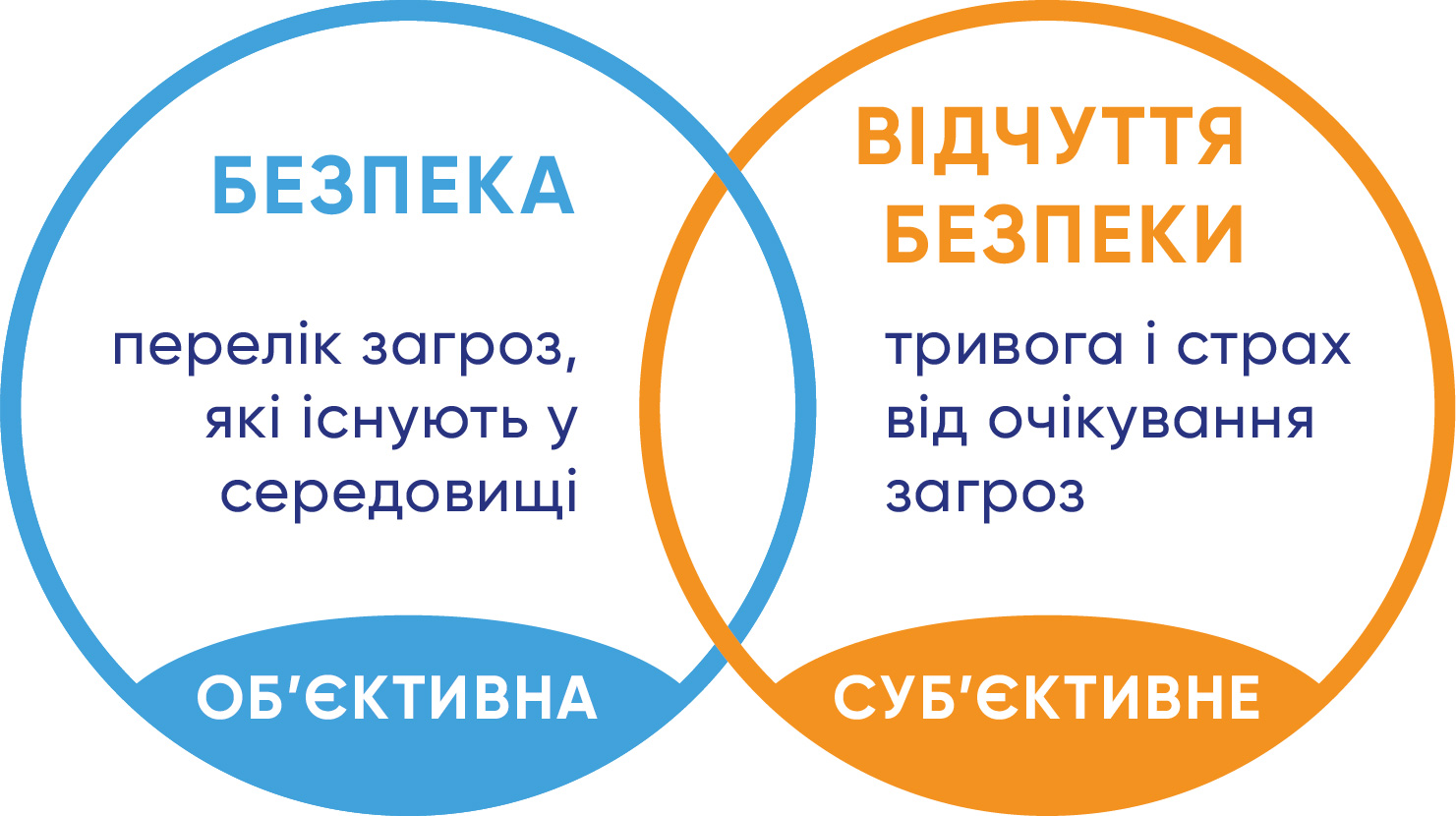
Let's immediately separate safety and the feeling of safety. The first is objective, covering the list of threats that exist in the environment; the second is subjective, involving sensations of anxiety and fear from anticipating threats. A paved path may look entirely reliable but conceal a hidden danger of ground collapse. So subjectively it is safe, objectively it is not. Conversely, an empty street at night may objectively contain no threats, yet walking along it can be frightening.
The main assumption of this article is that residents, together with the police, can increase the sense of safety in an environment. And then that sense of safety will influence the objective reduction of crime in the city. How? I'll explain now.
A few years ago my neighbor was robbed. It happened in the grove near our building in broad daylight. She was walking with a child in a stroller when a man approached her and, threatening with a knife, forced her to remove her gold jewelry. At the time we were creating an OSBB, and this issue became an important unifying factor.
My neighbor and I organized a residents' meeting on safety, where we worked not only on how to recover what was stolen but also on how residents could protect themselves in the future. During the conversation it became clear that this was not the first victim, and that many were afraid to walk through the grove. We, of course, heard despair and #betrayal at the meeting, we heard that nothing could be changed, that only the police could help here, or even better — the President… But we prepared and proposed to the community a list of concrete, simple steps to implement. We discussed, allocated responsibility among activists, and together implemented everything. Result? So far no other neighbors have been harmed, and the grove has become significantly safer.
Here are the steps we implemented. They are presented in general so they can be useful to other spaces and cities.
1. Increase visibility: lighting and openness of the space
Imagine what the area looked like before the changes. The path through the grove was about half a kilometer, with several turns, changes in elevation, mud, thickets and darkness. At the same time, it was the quickest route from home to public transport, the shop, the post office and the nearest school. Those who could hide in their own car or take a taxi mostly did so, especially in bad weather or after dark. But a large number of people had to use the path, and each time it caused them stress.
By calling the city's hotline, we learned who owned the land and who maintained it. We then contacted the named company, described the situation and asked them to mow the grass. The request wasn't fulfilled immediately, but a well-made request and persistence did their job — "Parents with small children are afraid to walk through the area you maintain… when can you schedule the grass mowing?" "When should we call you back?" and so on.
We were lucky that local elections were not far off. The path was paved and lighting installed with almost no effort on our part. However, don't be discouraged if elections in your area have just finished — send formal appeals to district administrations, including from an OSBB (condominium association), and clearly state what you want and what you can contribute. After the fifth request, things usually begin to move.
Lighting and openness of the space significantly changed the situation. A suspicious person can be seen from afar, giving you time to prepare — in our case we advised waiting for a neighbor and not walking the path alone. So openness is the enemy of the suspicious.
2. Upkeep: cleaning and repairs
I believe that upkeep of an area is one of the things we most underestimate. It seems that equipping a space, buying and installing equipment are the real costs, but maintaining the area requires at least as many resources, and its results are mostly invisible. On the contrary, neglect is what becomes noticeable.
The classic Broken Windows Theory asserts that visible signs of antisocial behavior and disorder create an environment that in turn causes crime and disorder. If you don't regularly cut back the thickets, they quickly grow back, and litter appears around benches that are now safe to sit on.
So our next step was to repeatedly remind the relevant services to mow the grass, replace a lamp in a streetlight, or trim excess branches.
Cleaning the area became another unifying factor for neighbors. The condominium association (OSBB) provided trash bags and gloves and posted notices in advance. Besides, after the cleanup people can order pizza or grill sausages together. Invite other buildings to take part — in our case these were several commercial organizations located on the other side of the grove. They turned the cleanup into one of their corporate responsibility and team-building events.
Two to three major cleanups a year are enough to keep the area from looking neglected; at the same time, rubbish bins should be installed near benches and someone should be assigned to empty them.
3. Presence of friendly people in the space
The presence of public spaces makes an environment feel urban. Unlike private spaces fenced off from view, a public space is an area everyone can use. The sense of safety depends on how attractive that space is to friendly (if not decent) citizens. Benches in dense undergrowth attract drinkers, but put a swing and a sandbox in an open, clean area — and children will likely displace antisocial groups. If those groups have an alternative nearby, the chance of displacement increases.
In our case the grove was divided into zones — the area around the path became a “white” zone, a little further on a dog-walking area was set aside, and even further on a place that could be called the “territory dominated by human weaknesses”»Ukrainian life is difficult, so it makes sense to designate a separate place for people who abuse alcohol; otherwise a separate area will have to be set aside for all other visitors to a given space. Consider whether it is comfortable to be in your city's parks or streets with small children, or whether they need to «be hidden» in specially equipped, enclosed children's centers with strict security.
Urban environments in Ukraine are changing. Partly thanks to help from international organizations, but largely because local communities are maturing and demanding better spaces for people. People and their quality of life drive city development, unlike Soviet (industrial) urban planning, where powerful enterprises — factories and plants — came first and people were simply transported from residential districts to work and back. The dynamics of life in such cities are shifting — people are starting to enjoy being in the city, walking or cycling. And instead of hiding in expensive cars and fortified homes, the middle class prefers to hang out in cafés, parks and other public spaces.
The balance is changing, and from a society of distrust we are gradually beginning to open up and overcome fear. According to an all‑Ukrainian public opinion survey conducted by the Kyiv International Institute of Sociology (KIIS) in 2018, the majority of people trust ordinary residents in their locality, and consequently deviant groups are gradually being pushed out of public spaces.
| Trust in social institutions, % of respondents | ||||||
| Omnibus, December 2017 | Omnibus, December 2018 | |||||
| Social institutions and population categories | Trust | Do not trust | Balance of trust and distrust | Trust | Do not trust | Balance of trust and distrust |
| Ordinary people in your locality | 73 | 8 | 65 | 68 | 12 | 56 |
| Volunteers who help the armed forces | 67 | 14 | 53 | 63 | 16 | 47 |
| Volunteers who help internally displaced persons | 65 | 11 | 54 | 61 | 14 | 47 |
| Churches | 57 | 17 | 40 | 51 | 23 | 28 |
| Armed Forces of Ukraine | 53 | 24 | 30 | 51 | 27 | 24 |
| Civic organizations | 37 | 25 | 13 | 41 | 25 | 16 |
| Internally displaced persons | 35 | 20 | 14 | 37 | 21 | 16 |
| Ukrainian media | 26 | 43 | -17 | 31 | 42 | -11 |
| Patrol Police | 33 | 33 | 1 | 30 | 45 | -15 |
| National Police | 23 | 44 | -21 | 29 | 49 | -20 |
| Opposition | 13 | 59 | -46 | |||
| Pro-European opposition (Batkivshchyna, Samopomich, etc.) | none | none | none | 24 | 47 | -23 |
| Security Service of Ukraine (SBU) | 12 | 47 | -35 | 21 | 48 | -26 |
| Opposition from the former authorities (Opposition Bloc, Za Zhyttia) | none | none | none | 16 | 58 | -42 |
| President of Ukraine | 14 | 69 | -55 | 16 | 70 | -54 |
| Government of Ukraine | 10 | 73 | -63 | 11 | 74 | -63 |
| Russian media | 2 | 76 | -74 | 4 | 75 | -71 |
| Verkhovna Rada of Ukraine | 5 | 82 | -77 | 8 | 80 | -72 |
| Source: KMIS | ||||||
Those who maintain such places and spaces are shifting priorities: instead of merely preserving and guarding them, they begin to help people enjoy shared spaces. We hear the angry “don’t walk on the cleaned floor!” less often, and when we do it’s more about safety on a slippery surface than about violating sacred cleanliness. Managers of areas and spaces aim to make them places where people want to be, where you feel at home and have a sense of belonging to the environment, the neighborhood, the city.
4. Constructive cooperation with the police
Get to know your district police officer. Direct requests to them and ask about progress. In our case we kept asking the officer how things stood and what we could do to help. Together with the officer we organized evening patrols while the grass in the grove had not yet been mown and lighting had not been installed. Of course the likelihood that a patrol would encounter a criminal was small, but the presence of officers reduced the feeling of neglect.

Residents still did not trust unreservedly. But meeting the district officer at least opened a window for building further trust.
A state of constant anxiety is exhausting. In any case, we want confidence in life: to be able to rely on institutions and to think about things beyond the constant struggle to survive. Perhaps police officers want that too.
Once basic needs — including the need for safety — are satisfied, a person begins to consider higher-level needs, notably caring for the environment and feeling responsibility for the development of their city and country.
