

Safety Program
Ihor Brynosh,
Coordinator of the Public Justice Center and the Security Coordination Office,
expert and trainer in community development
Think Strategically, Build a Safe Community Institutionally
A safe community is a concept far broader than public order and entails a substantial share of responsibility for local self-government. But even here one should not be limited to a single local program or the currently popular installation of video surveillance. Effective development of a safe community environment is about strategy and prioritizing tasks; about using a range of financial instruments; about engaging the community and fostering innovation. Moreover, decentralization reform gives communities both more opportunities in this area and greater responsibility.
Community safety is not just public order
Community safety — in a specific city, town or village — is not exclusively within the police's competence, as is often assumed. It is a complex concept, much broader than maintaining public order, and includes road safety, public health, environmental safety, safe infrastructure and other factors that allow residents to feel secure. Achieving this outcome is possible only through the joint participation and responsibility of the police, other local authorities, local self-government bodies and community residents.
Responsible local authorities should prioritize ensuring safety in their territory, since the level of safety affects investment and tourist appeal, internal migration, business development, and the community's cultural and social life.
Key responsibilities of local self-government in community safety include:
- public space upkeep;
- management of stray animals;
- authorization to install road signs, pedestrian crossings, speed bumps, and to remove vegetation;
- issuing permits for service-sector commercial outlets and approving their operating hours;
- operation of municipal police, including community patrols and guards;
- activities in the field of civil protection;
- operation of the video surveillance system.
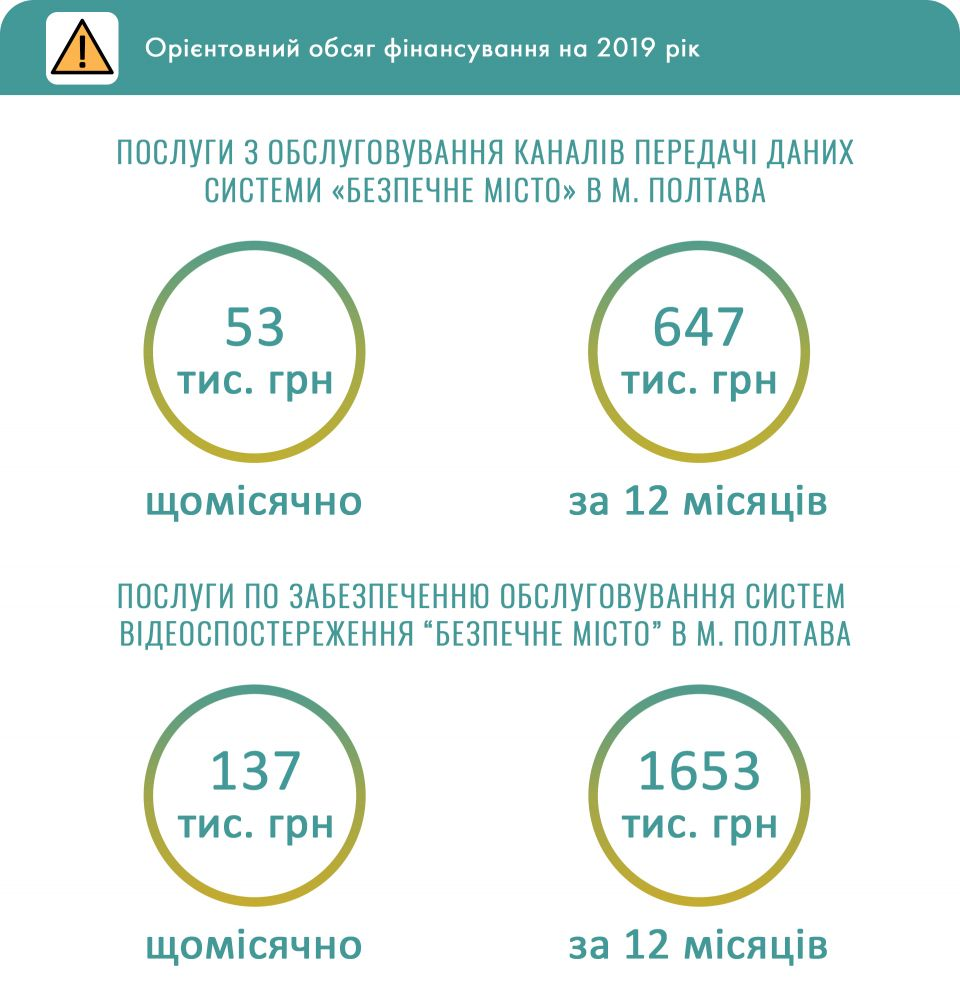
Infographic for the Poltava City Council's “Safe City” program. Photo:https://zmist.pl.ua/
Importance of a Safe Community Development Strategy
A safe community development strategy, whether part of the overall community development strategy or a separate document, should define priority directions, goals and tasks for the community's sustainable development in a dynamic environment, taking into account risks and opportunities.
The absence of an integrated system of strategic planning prevents adequate budget planning and weakens the links between budget programs and the community's development priorities. Any security or related program is not an end in itself or an independent element; it is one component of the safe community development strategy and must be organically integrated with it.
When conducting strategic planning, the following principles must be observed:
- involving all community stakeholders in the strategy development process;
- implementing priority tasks taking into account the community's available resources, capacities and powers;
- open access to the preparation, presentation and discussion of strategic planning results.
It is also necessary to understand that the community's security issues are addressed by different actors. Some problems can be resolved by the police; others fall within the exclusive competence of local self-government; many issues require coordinated efforts by multiple bodies.
The Sambir District Council approved the Concept of Comprehensive Security for Sambir District and the Measures to the Concept on 17 March 2016. Responsibility for the measures was assigned to the police as well as local self-government bodies, the district administration, city services, school administrations, transport company management and others. The concept takes into account the district's specifics and was developed based on both resident surveys and assessments by the police and local activists.
Key issues in the development and implementation of local programs
The program-target method is used when implementing local programs. The program-target method is a budget management approach for achieving specific results with budget funds, applying assessments of the efficiency of budget fund use at all stages of the budget process. The purpose of this approach is to establish a direct link between the allocation of budget funds and the results of their use.
In the broader understanding of a safe community, several types of local programs can be used:
- “Safe Community” programs in a city or settlement;
- programs for improvement and infrastructure development;
- programs for dealing with stray animals;
- programs for crime prevention and for ensuring public safety and order;
- programs to counter and reduce the harms of drug addiction;
- programs for public legal education.
Currently, a common practice is the implementation of “Safe City” programs, which are primarily aimed at operating video surveillance systems and rapid response to offenses. It should be noted that such systems in communities often operate without proper documentation and have problems with analysis, storage and use of the data obtained.
The “Safe City Chuhuiv” program for 2019–2021 with a budget of UAH 3,190,000. It includes a video surveillance system and a software suite at critically important facilities and city protection sites. It provides video control and surveillance of urban locations with large concentrations of people, including squares, streets and other places of mass congregation, and public transport vehicles — i.e., potentially criminogenic areas of the city — with transmission of operational information to a monitoring center for subsequent data storage and processing, license plate recognition, vehicle movement tracking and the creation of archival data.
The Chortkiv City Council’s “Safe City” program for 2019–2022 with a budget of UAH 1,600,000. The main objective of the program is to implement a comprehensive “Safe City” security system based on modern means of video surveillance, safety, monitoring, control, communications, management and rapid response.
A typical structure of a local community security program consists of the following components:
- Preamble– the introductory section, general provisions. It includes references to legislation, to the principles for preparing the program, an overview of the program structure, and information on any studies conducted in the community.
- Relevance– justification of the program’s necessity, including changes in legislation, reforms in relevant sectors, a description of dangers and risks in the community, a description and results of existing related activities in the community, and a summarized description of required activities and measures.
- Goal and objectives– the goal is stated based on the problem description, expressed as an improvement in the situation; objectives are listed as specific directions and measures to achieve the goal.
- Resources –description of the types and amounts of resources: funds, material assets, engaged individuals, bodies and organizations.
- Results– a clear, detailed description of specific quantitative and qualitative results that relate to the program's tasks.
- Implementation control –identification of the entities that exercise control over program implementation, with specified powers, timelines, and procedures.
As practice shows, when drafting budget programs the greatest difficulties arise in formulating the program's goal, tasks and results, so we will address these components separately. The goal is the final outcome achieved through implementation of the budget program; it must be realistic and attainable. Tasks are a concrete set of measures that should be result-oriented, expressed in quantitative terms and have specific deadlines. When formulating tasks, general statements should be avoided, since the program's budget is justified on their basis. A program may contain several tasks that define the ways to implement the program and are subject to verification.
The greatest challenge in preparing a budget program is arguably formulating performance indicators. The use of clear performance indicators allows demonstrating the effectiveness of the use of budget funds, assessing the duration of program implementation, and determining its necessity and the achievement of the planned social effect. Also, when setting any performance indicator, one must clearly understand and specify which objective measurable data will be used to assess its fulfillment. Several groups of indicators are distinguished, which can be combined when preparing specific programs.
- Expenditure indicatorsdetermine the amounts and structure of the resources that ensure implementation of the budget program.
- Product indicatorsspecify the volume of goods produced, services provided, or work performed, and the number of users of specific goods, works, or services.Efficiency indicatorsdepending on the program's objectives, can be defined as resource expenditure per unit of product (economy), the ratio of the maximum number of products produced to a given amount of financial resources (productivity), and the achievement of a specified result (effectiveness).
- Quality indicatorsare a set of characteristics that describe the achieved quality of the produced product, satisfying consumers according to its intended purpose, and reflecting reductions in negative or increases in positive trends in service delivery, product manufacturing, or work performance.
When implementing local safety programs, keep in mind the key stages of preparation and implementation:): Developing the program draft with broad community involvement. Formalizing the program as a draft decision — either a new program or amendments. Securing support for the draft decision in the council committee. Securing support for the vote at the local council session. Implementing the program. Monitoring implementation. Analyzing and evaluating the program's impact.
Ability to influence your community's budget
BudgetBudget is the key tool for managing a community and for implementing relevant priorities and goals, including community safety. The annual budget cycle includes five stages: preparing the budget forecast, drafting the budget, reviewing and approving the budget, executing the budget, and reporting on budget execution.
How a community can influence its budget:
- Preparing the budget forecast (July–September).Submit proposals to departments and to the finance department. Participate in expert and advisory bodies.
- Drafting the budget (May–October).Submit budget proposals to deputies and directly to the local council. Participate in expert and advisory bodies.
- Review and approval of the budget (November–25 December).Participate in budget hearings and express your proposals on the budget draft. Attend meetings of the budget committee, executive committee and council sessions. Help disseminate and discuss the adopted budget decision.
- Budget execution (January–December).Initiate public monitoring of budget execution, attend budget committee meetings and council sessions where budget issues are considered.
- Reporting on budget execution (January– 15 March).Participate in discussions of the budget execution report during its public presentation. Attend council sessions where the budget execution report is approved. Initiate a public audit of the executed budget—both for specific areas and overall.
Participatory budgeting as a tool for funding security initiatives
Participatory budgetingis a democratic process that gives every citizen the opportunity to take part in allocating local budget funds by preparing projects to improve the settlement and/or voting for them. Any resident of a city or town can submit a project related to improving community life, enter the competition, win in the vote, and observe how their project is implemented within the budget.
Funding for participatory budgeting is usually allocated each year from the community budget; in some cities the implementation of participatory budgeting is regulated by a targeted time-limited program. In most cities projects are divided into large and small—an average small project is allocated 200–250 thousand UAH, and large projects range from 250 thousand UAH to 1 million UAH.
In many communities, security projects are financed through the participatory budget instrument:
In the Poltava City Council, within the “Participatory Budget 2018,” the project “Safe City” was supported, aiming to illuminate pedestrian crossings in Poltava. The project provides for the installation of autonomous sensor lighting systems at the pedestrian crossings that are most dangerous in Poltava. The total cost of the project was 1.4 million UAH.
In the Zhytomyr City Council, within the “Participatory Budget 2018,” the project “Street Video Surveillance in the Malykova Neighborhood: ‘Glad to See You’” was supported. Thanks to the project, 41 vandal-proof street IP cameras were installed. The video surveillance system, which includes automatic license plate recognition and visual identification of faces, provides round-the-clock monitoring and control of vehicle entry and exit points to and from the neighborhood, infrastructure facilities, recreation areas, and the territory adjacent to apartment buildings. Video footage from the IP cameras is stored in the archive for at least 30 days. The project budget is almost 1.5 million UAH.
Thanks to the city target program “Public Budget of the City of Kostiantynivka” for 2019, the implementation of the project “Face of Security” was planned—the purchase of presentation uniforms for the public order protection formation “Haidamaky.” The project budget is 69 thousand UAH.
Thanks to the Civic Budget of the Huliaipilska Hromada for 2019, children from the villages Huliaipilske, Myrne and Charyvne will be able to practice road safety rules hands‑on. The "AutoCity" project is an area for learning safe road behaviour, as well as for recreation and physical activity in the yard of Huliaipilska Secondary School. Project budget: UAH 86,000.
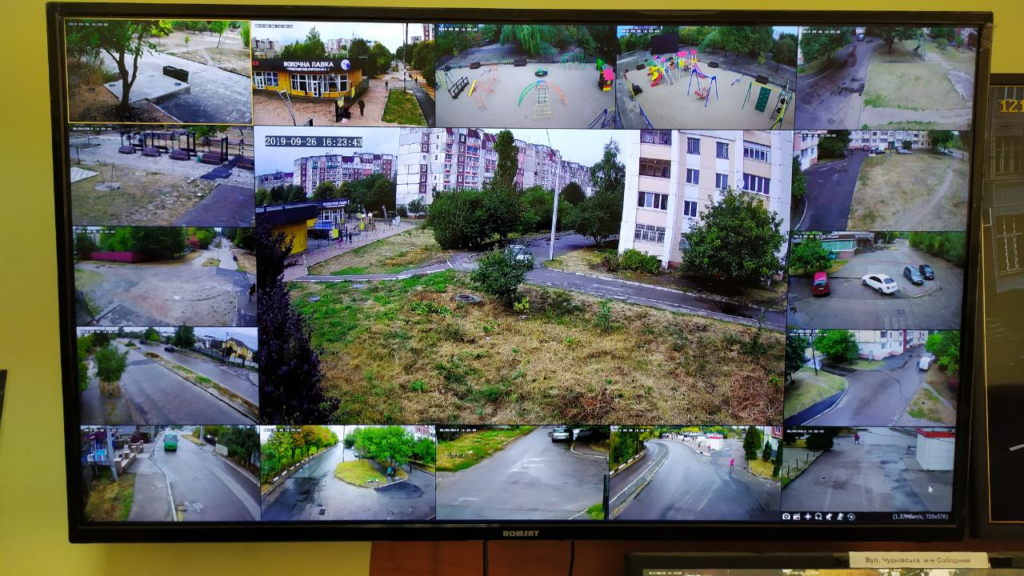
Test trials of the street video surveillance system in the Malykova neighborhood of Zhytomyr, installed with participatory-budget funds. Photo: Official website of the Zhytomyr City Council.
Co‑financing of security initiatives
Co‑financing of security initiatives can provide additional resources.
For example, in the city of Izmail in Odesa Region the project "CBC‑Safety – Prevention and fight against organized crime and police cooperation through border centres on the Romania–Ukraine border" will be implemented. Project partners are the Municipality of Tulcea (Romania) – lead partner; the Executive Committee of Izmail City Council (Ukraine); the Tulcea County Police Inspectorate (Romania); and the Main Directorate of the National Police of Odesa Region (Ukraine). The total project budget is €1.4 million, of which Izmail City Council’s contribution is €474,000. Through implementation of the project, bilateral relations between Romania and Ukraine—and primarily between police units, border police and local police units—will be strengthened through exchange of best practices and joint participation in capacity‑building seminars, improvement of investigation and information‑verification methods, and the transfer of experience in preventing and combating cross‑border organized crime, including illegal trafficking in cigarettes, people, drugs, organs, weapons and other goods.
The project also has an infrastructure component. In particular, a Transborder Centre for the Prevention and Fight against Organized Crime will be established in Izmail. Within the project, a citywide video monitoring system will be implemented in Izmail and modern SMART cameras will be installed. The entire surveillance system is planned to be integrated into the unified regional system of Odesa Region, gaining access to cameras installed on roads in Izmail district, at borders with other states, and connecting to a server for facial recognition.
Operation of the municipal guard
The practice of creating and operating a municipal guard is currently developing actively — a body within the local self-government system funded from the corresponding local budget. The main tasks of the municipal guard are maintaining public order, preventing offenses, informing internal affairs bodies and units about crimes committed or being prepared, and protecting property in communal ownership. The municipal guard is also entrusted with oversight of compliance with land and environmental protection laws, maintaining the improvement of public areas, keeping streets, parks, squares and residential-adjacent areas clean, monitoring vehicle parking, protecting monuments, and organizing trade, public catering and household services.
At the same time, in the Ukrainian context there is a threat that municipal police could be turned into a forceful tool by local politicians to resolve political or business issues.
Municipal police in Vinnytsia were established in 2013 to monitor the state of urban maintenance, ensure cleanliness and order, organize greening, protect green plantings, water bodies and the city’s land resources, oversee public recreation areas, and ensure quiet in public places within the city.
Recently, one area of work has become bicycle patrols composed of municipal police officers. They monitor compliance with city maintenance rules and, if they witness more serious offenses, call in the patrol police. Recently Vinnytsia’s municipal police introduced another channel for residents to report maintenance violations — via the Viber mobile app citizens can send a photo, provide the address and submit it to the number. Citizens actively report violations to the municipal police; the most common are improper vehicle parking and leaf burning.
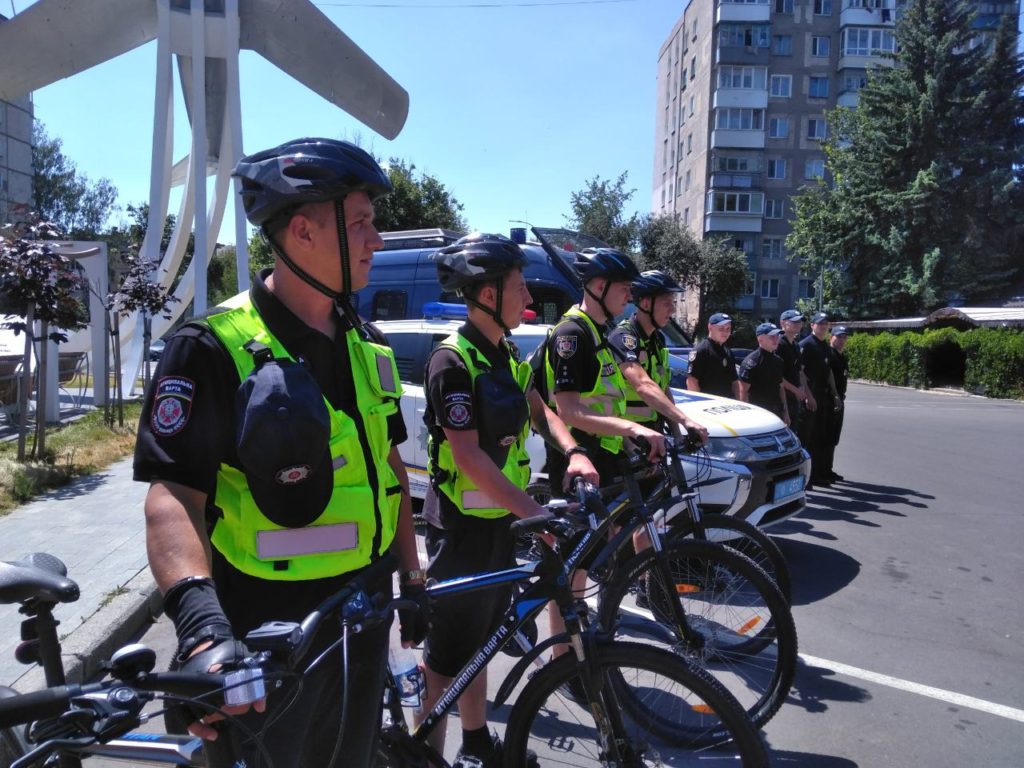
Joint bicycle patrol of the municipal guard and the police in Vinnytsia. Photo: Facebook Municipal Guard of Vinnytsia.
Creation of Safety Centers
One prospect for local government involvement in ensuring safety in united territorial communities (UTCs) is the creation of Safety Centers. The establishment of a community Safety Center follows a comprehensive approach — each center will house a fire station, a community police officer’s office and, if needed, feldsher-midwife points. Opening such centers helps address population protection more effectively and comprehensively and fosters close cooperation between emergency services and community residents.
In 2017, the first Citizens’ Safety Center in Vinnytsia region was created in the village of Zhdanivka, Khmelnytskyi district, funded by the united territorial community. Under one roof three services were combined — a fire unit, a police precinct and an ambulance point. In communities of Zhytomyr region, 32 multifunctional Safety Centers were planned to be established by the end of 2020. These centers will bring together rescue services, medical care and a police office coordinated by a single dispatch service.
Accordingly, for safety to become a long-term characteristic of your community, it is necessary to have a strategic vision of a safe community, to use local budgets and investments effectively, and to involve the community itself as much as possible in these processes.
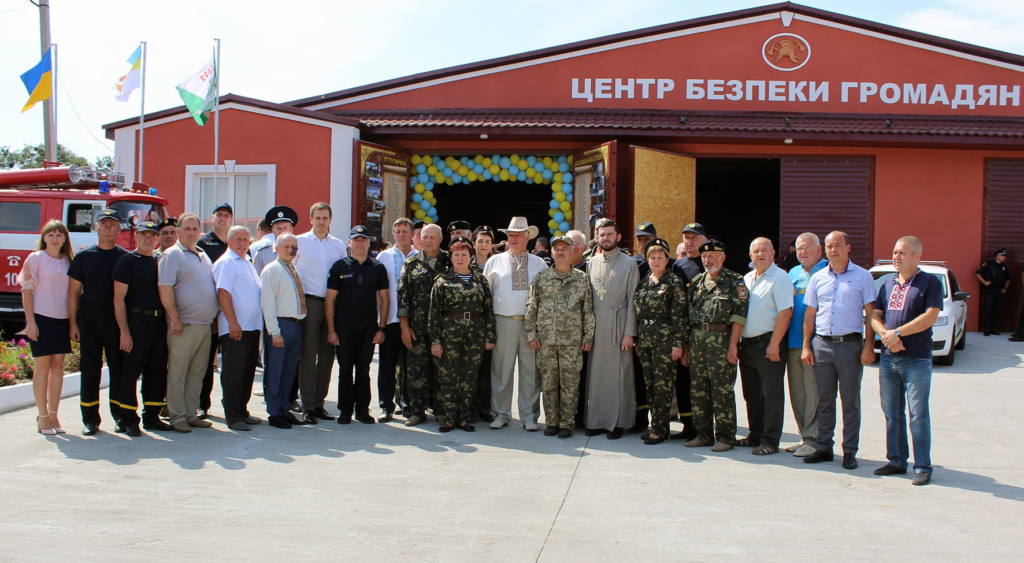
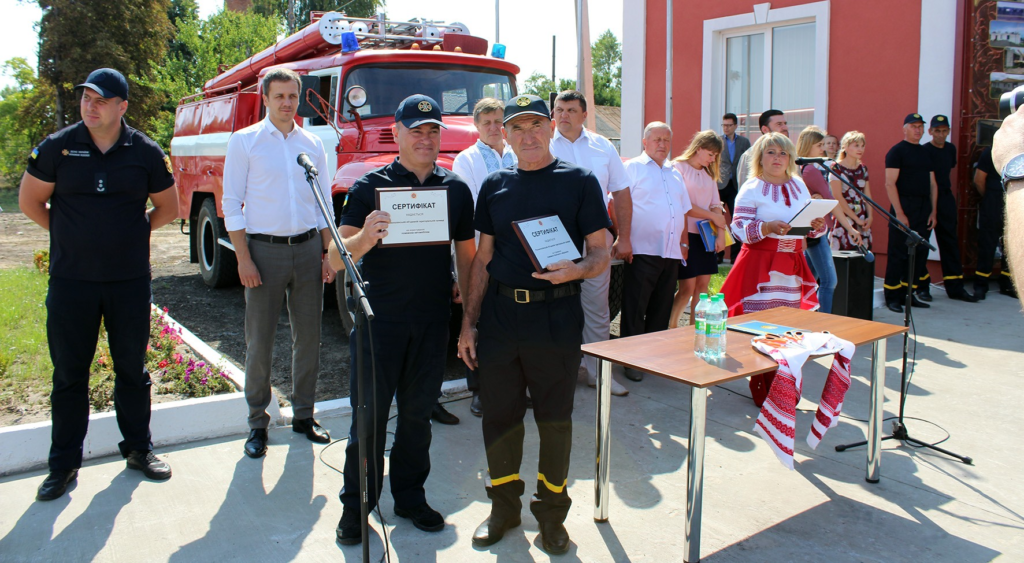
Ceremonial opening of the Citizens’ Safety Center in the Ruskopolianska united territorial community, Cherkasy Oblast. Photo: Facebook of the State Emergency Service of Ukraine in Cherkasy Oblast.