

Budgeting for security initiatives
Olha Nastina, PhD in Law,
expert in community safety development
Safety in communities is a multifaceted concept.People assess and understand safety differently. Usually, safety primarily refers to instruments for organizing public safety and law and order: municipal police and municipal guards, creating police stations and community formations. However, safety is also understood as road safety, street lighting, and accessible spaces for people with disabilities. Security issues include the introduction of new technologies in the environmental sphere: thermal modernization, thermal renovation, energy saving and energy audits, safe waste management, water distribution management, water supply, wastewater disposal, civil defense measures and many other areas. This text is about budgeting for security initiatives — specifically how and where to find money to implement them. We will examine the process of finding financial resources to create a safe environment in communities and lobbying for funding of security initiatives from local budgets.
To understand each other,let's agree on terminology.
Budgetingis the process of determining the amount and composition of expenses related to a specific activity in order to ensure those expenses are covered by available budgetary resources.
Security initiativeis any initiative, idea, or project related to creating an environment in the community that is safe for its residents. It can be anything — from waste sorting, street lighting, installing video cameras, renovating sidewalks, and installing ramps to self-defense courses for women, sign language training for police officers, and introducing the GOB principle — gender-responsive budgeting.
How can a security initiative be made viable so it engages relevant authorities and stakeholders, attracts attention, wins majority support, and, most importantly, secures funding within the community?
Remember, that The authorities will never provide funding for the best initiative if the request for it is not endorsed by the community itself.It must be not just an idea, a proposal, but above all a necessary, well-argued and carefully calculated project.!
So let’s go through the whole process from idea to its implementation and funding.
Launching a Security Initiative
1. One person may be a warrior, but together it’s easier to overcome the problem
If you have a security idea, start by finding allies. You should and must look for people who share your understanding of the security issue, because the final decision will be made in government offices, and a collective “people’s voice” is more likely to be heard. You will never involve everyone, but at the start two or three people are enough to begin initial discussions with other stakeholders.
2. A security initiative must be grounded in a real problem that is relevant to the community.
Find out what worries not only you personally but other people in the community, neighborhood or microdistrict. Talking with neighbors will help you understand which issues concern them from a security perspective. A public survey can be useful — the simplest and least expensive way to identify the problem, assess people’s attitudes toward it, learn the community’s vision for solving it and expand the circle of like‑minded supporters.
Tips:
- Make a list of current security issues
- Leave room for open questions (people may be concerned about issues not on your list).
- Find volunteers and committed people to conduct the survey (these can be university students, civic activists, acquaintances, or friends).
- The more respondents, the more weight the results have.
3. Set priorities
Focus on the most pressing safety issues identified during the survey.
To single out the most important issues, gather with like-minded people and interested stakeholders. For example, hold local meetings for your neighborhood, street, or village, and at the meeting determine priority tasks and possible solutions by voting.
Tips:
- Focus on one or a few safety issues.
- Discuss ways to solve the problem: when dealing with authorities, it’s better to come with proposed solutions and clear community expectations.
- Hold a vote and record the decisions in the minutes. This lets people feel responsible for the decisions made and, in the case of constructive dialogue with authorities, provides an additional argument for a considered collective decision.
4. Arm yourselves with statistics.
The more evidence of the problem’s existence, the better. The issue’s relevance should be supported by verified and documented facts. Filing information requests for access to public data from the relevant authorities can help—for example, requests about evening traffic accidents on unlit streets, injuries on sidewalks not cleared in winter, or hooligan attacks near abandoned construction sites.
5. Find partners and allies
Entities responsible for community safety include local authorities—relevant departments and services—police, emergency services, ambulance, municipal emergency utilities, municipal guard, community formations, self-organization bodies, homeowners’ associations, etc. To initiate partnership with any of them, organize face-to-face meetings or direct appointments with officials or responsible persons.
Tips:
- Identify the body responsible for resolving the problem—typically a government authority.
- Focus on resolving the problem and constructive dialogue rather than 'political debates' or assigning blame.
- Make a list of interested parties or stakeholders. These can include city or village council members, a local farmer or entrepreneur, a respected community figure, etc. Depending on whom you identify as the target audience, the list of partners and stakeholders will vary.
6. Arguments in favor
At this stage, carry out an assessment of the risks and budgetary losses from not resolving the problem and the benefits of resolving it as soon as possible. It helps to analyze the costs the community will incur from not addressing the priority issue in both the short and long term: financial costs, human losses, material damage, intangible losses, etc.
Tips:
- Quantify the arguments in favor and calculate the unjustified costs borne by the community and the budget losses from not resolving the problem.
- Try to calculate the gains—how much the budget, the community, and people will save from the changes you propose.
- Draft a well-founded, calculated proposal to the competent authorities outlining your reasoning.
7. Seek resources
Try to find financial resources independently to implement the security initiative. The main funding sources are state, regional, and local budgets, while supplementary sources include donor grants, businesses, and personal funds.
BUDGETING
We'll discuss where and how to find resources to implement a security project below.
However, first it is worth addressing the questionbudgeting for security initiativesA lack of understanding of how budget funds are managed and ignorance of basic budget processes can result in even the most well-founded proposal being stopped at the outset due to the initiators' lack of knowledge and professionalism.
Next we'll look at how to include the necessary expenditures for implementing such initiatives in local budgets.
Budget funds
Budget funds may be used only according to the rules:
- Funds must be included in the local budget
- Funds are allocated for implementing budget programs
- Budget programs must include a list of activities on which budget funds may be spent
- The program and its activities are developed by financial authorities at the request of the budget manager
- Budget managers must find implementers to carry out the program activities
Soin detailabout these rules
Budgets at all levels are formed on the basis of a budget program — a document that must include the program profile, program activities, financial indicators and justification of the efficiency of budget spending, program implementers, performance indicators, and the purpose for which the budget funds are spent. Thus, budget funds can be spent only if they are "provided for", i.e. included in the relevant program.
For the implementation of budget programs, the mainbudget managers— institutions, services and units of local self-government to which funds are transferred to implement the program's objectives and carry out its activities.
Responsible implementer of budget programsis designated by the main budget manager in agreement with the local financial authority.
The responsible implementer of a budget program ensures the targeted and efficient use of budget funds throughout the program's implementation period, within the approved budget allocations.
Attention! The implementer of security initiatives — the implementer of measures under budget programs — can be either legal entities (civil society organizations) or individuals with the appropriate status (individual entrepreneurs, lawyers, etc.).
Program activities– these are specific activities provided for within the budget program for which funding is allocated.
Important to know!All programs adopted by the community are included in the so‑called “consolidated program” — the Program of socio‑economic (and cultural) development of the settlement. An annex to this program lists all targeted programs planned for implementation in the relevant budget year. These are the programs that can be financed and implemented by the community that year.
To summarize:To implement a security initiative and obtain funding for it, you need to initiate adoption of a relevant budget program in the community or review existing programs to add a security component and advocate for inclusion of security measures and their financing.
Therefore, for a security initiative to be implemented, it is necessary to have:
- The existence of a separate targeted security program (e.g., “Safe City,” “Security Passport”), or another program related to security — for example, funds for street lighting may be included in a local program linked to organizing security measures.
- Provide for security measures in the specific action plan contained in the annex to the relevant program.
- Have a cost estimate for the expenditures to be financed.
The question arisesWhen exactly should you start lobbying to include expenditures for a security initiative in the local budget?AnswerIf you plan to obtain funding for the next year, begin advocating for the security initiative at the start of the current year. A budget calendar will be useful.
Important!As early as August, local financial authorities analyze the performance and effectiveness of this year’s budget programs and begin planning next year’s budget. Therefore, by August you need a well-founded, community-supported idea for a security initiative so it can receive funding next year.
| Budget calendar | |
| Analysis of program performance and program passports | August |
| Decision to include budget requests in the draft local budget | 10 December |
| Coordination with budget managers and chief budget managers on draft local budget proposals regarding: prioritization of budget programs; the composition of the development budget; socio-economic development plans. | 20 December |
| Preparation of the draft local budget: for the planned year (revenues of the general and special funds); for the development budget. | 25 December |
| Publication of the draft budget and the development budget | 30 December |
| Adoption of the local budget by the relevant council session | Two weeks after the publication of the State Budget Law |
Also consider the budget process
If the community plans to adopt a security program or amend an existing program to develop its security direction, keep the following in mind.
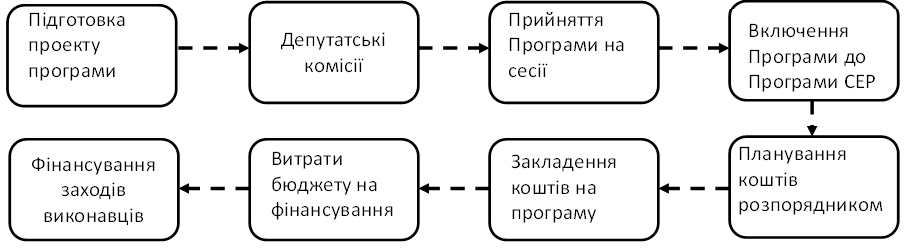
- Anyone can initiate a new budget program, but bringing the matter to a local council session for consideration may be done by the head of the relevant council, a council member, or a coalition of council members.
- Councillors review the draft program in council committees. It is there that it is approved or rejected, and if approved the next stage is a vote for or against the program at the council session.
- If the program is supported by councillors, it is included in the list of the community's socio-economic development programs, and if funding is provided for specific measures the budget manager plans the corresponding expenditures, allocates funds for its implementation, and organizes financing for the program's implementers.
Important!Programs may not include funding if their measures do not require expenditures. Therefore, when lobbying for security initiatives it is important to have accurate or realistic estimates of the likely necessary costs.
Budget process
Finding funding sources to address security issues
State budget funds
Currently, the state budget allocates significant sums for implementing security projects in united territorial communities through the infrastructure regional development fund. The funds — essentially a subvention — are distributed to communities via the State Fund for Regional Development (DFRR).
DFRR funds can be directed to: development of design, urban planning and planning documentation; improving the quality of administrative services; creating modern systems for community governance; reconstruction, re-equipment or repurposing of buildings of budgetary institutions in united territorial communities; new construction, reconstruction and major repairs of streets, roads, bridges and communal crossings; procurement of vehicles for transporting children to educational institutions, special-purpose vehicles, and similar needs.
Let's consider a case Ministry of Youth and Sports of Ukraine
The relevant ministry may not appear directly related to security issues. However, youth initiatives by civil society organizations can potentially be directed at addressing security problems in the community.
There isan ordera ministry document outlining the implementation of programs, projects and activities in the youth sector. It includes references to ways funds can be used to implement state youth policy and provide state support for youth public organizations.
The ministry can financially support projects of public organizations and fund their implementation. Of course, such a project can be a security initiative.
The same applies to funding children's and youth public organizations that address issues of children, youth, women and families. These can be security initiatives and projects, for example aimed at preventing domestic violence.
Also notethe state targeted social program “Youth of Ukraine” for 2016–2020, which is also a potential source of funding for youth security initiatives. The funding scheme is similar to the one discussed above.
Regional budget
You may also find it usefulknowledge of programs financed from your region's budget. The first step to obtaining this information may be a request to the regional state administration.
Moreover, both at the local and regional levels there are lists of programs funded from the regional budget.
Important!Proposals to deputies and regional budget fund managers to allocate relevant expenditures and provide for specific measures can come from the public!
Local budget funds
In addition to targeted local security programs, communities may have other programs as well.
Pay attention to the content of the following programs, as they may help you secure funding for a security initiative:
- programsanddevelopment of civil societyas they have been adopted in almost all communities.
- programs to promote the social development of youth and families
- programs supporting local social initiatives
Examples of such programs in the cityDolynskand inVelytska community. - a program to address social problems by implementing a social contracting mechanism
Example such a program in Bila Tserkva
Steps to implement the program: -
- establishing a working or initiative group
- assessment of social problems
- recommendations for program content
- decisions of local self-government bodies approving the Regulations on social contracting
- program funding
- conducting a social contracting competition
- dcommunity budget (participatory budget) – arguably the most common source of funding for security projects. For example, the case of the program Participatory Budgetas exemplified by Kyiv.
CONCLUSION
So, to sum up. To introduce security initiatives funded by the community, remember that an idea or proposal to improve safety in the community must be backed by community demand — surveys, risk and benefit assessments, and preferably well-founded calculations — it should be a true community project.
To implement such an initiative, you need to familiarize yourself with the budgeting process, and it is better to start lobbying for it at the beginning of the year so that funding can be secured for the next year.
For financing the initiative, it must be included in the activities of a specific budget program adopted by the relevant local self-government body, or by making amendments to an existing local program.
In addition to local security programs, the community budget (participatory budget), programs supporting local social initiatives, initiatives within civil society development programs, programs for solving social problems through social contracting, regional budget programs, and funds from the State Fund for Regional Development can all be useful.
A budget initiative can also be implemented by seeking donor funding or engaging private partners; for this, you may need a budget calculation for your proposed project.
Wishing you success in implementing your security initiatives!
Materials used:
Security Initiative: From Idea to Implementation
Brochure: "Experience of Ukrainian Communities in Cooperation with the Police"
Community Police Officer
https://www.kmu.gov.ua/news/v-ukrayini-zapustili-proekt-policejskij-oficer-gromadi