

Community safety: components

Safety is people’s sense of security, comfort, and social well-being, not merely the absence of threats or a low level of crime.
"When I can walk around the city at night and not be afraid that something bad will happen to me — that I'll be robbed, hit by a car, or attacked."
"Safety is when I forget to lock my door at home and I'm not afraid my apartment will be robbed."
"When I'm confident that the ambulance will actually arrive and the doctor will be professional."
At first glance, these demands can be easily met by installing video surveillance systems and increasing the number of patrols on the streets. But if you listen more closely, you can detect between the lines people's need for certainty, trust, and peace of mind, a desire to be able to rely on state or
public or community institutions, and on their neighbors.
SoThe Institute for Peace and Understanding understands community safety somewhat more broadlyIt, in our view, includes not only existing video surveillance systems, street patrols, fire safety and road safety, access to healthcare facilities and other security mechanisms, but also components such as: – community cohesion, a high level of trust within it;
- coordinated communication among stakeholders;
- police-community interaction, involving residents in solving local problems;
- leadership potential of community members;
- integration of vulnerable social groups into the community.
Such a comprehensive approach makes it possible to see the fullest picture of community development, in which safety is a component of stable economic growth and a guarantee of social well-being.
We also believe thata strategy/program to create a safe environment is, first and foremost, a strategy for risk management in the communityAttention to security challenges and the search for potential "growth points" in the community's strategic development directions have become our priorities.
IMiP works to improve safety levels in communities through (a) developing community capacity to design and implement safety programs; (b) increasing the community's expertise on security issues; (c) establishing communication and cooperation among key actors that influence the formation of safety; (d) developing the community's adaptability to challenges. One of IMiP's main tasks in shaping community safety is increasing communities' resilience to security risks in the medium and long term.
Components
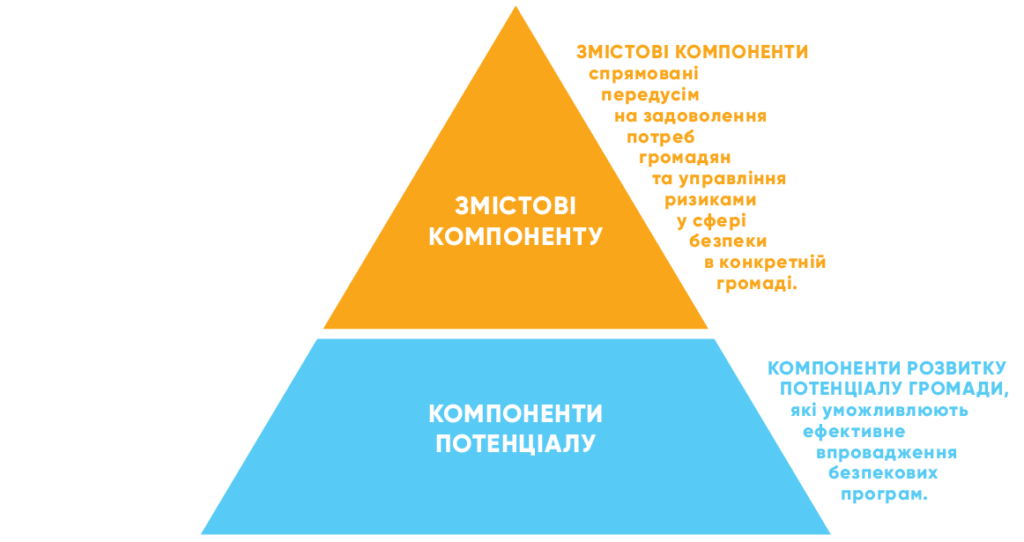
Depending on existing challenges/risks and residents' needs, each community requires an individually designed safety program. We have identified a complete and universal spectrum of SAFETY COMPONENTS — both those that make up its substantive content and those related to strengthening community capacity in the field of safety — which enable the formation of a safe environment. From this spectrum, each community can choose the set of components that best matches its safety needs and articulated development vision. The level of engagement for each component is also selectable.

This material was prepared with the support of the European Union and the International Renaissance Foundation as part of the joint initiative "European Revival of Ukraine." The material represents the authors' position and does not necessarily reflect the views of the European Union or the International Renaissance Foundation.