

Security Risk Analysis
Ihor Brynosh,
coordinator of the Public Justice Center and the Security Coordination Office
expert and trainer in community development
Investigate to understand and influence community safety
All communities are unique, so it is impossible to effectively address problems without a preliminary diagnosis of the security situation. It is like medicine — without blood tests, X-rays, or an ECG you will not be prescribed treatment, because it would be ineffective or even harmful. The same applies to building a safe community. Without understanding specific security problems and challenges, without assessing the capacity of key actors, and without a sense of cooperation and coordination of efforts, it is impossible — and even contraindicated — to make operational, let alone strategic, decisions. Therefore, if you want to understand and influence the development of a safe community — investigate! A quality diagnosis of the community's security situation is the first step and the foundation of any initiatives and activities to create a safe environment.
The "security passport" approach
During 2017–2018 the Security Coordination Office in the city of Tatarbunary, administered by the Odesa Regional Organization of the All‑Ukrainian NGO "Committee of Voters of Ukraine", developed and practically tested an innovative universal approach for diagnosing a community's security situation — the "security passport". One analytical document consolidates as much information as possible about the full spectrum of security problems in the community and about the potential and capacity of all stakeholders to develop a safe community environment.
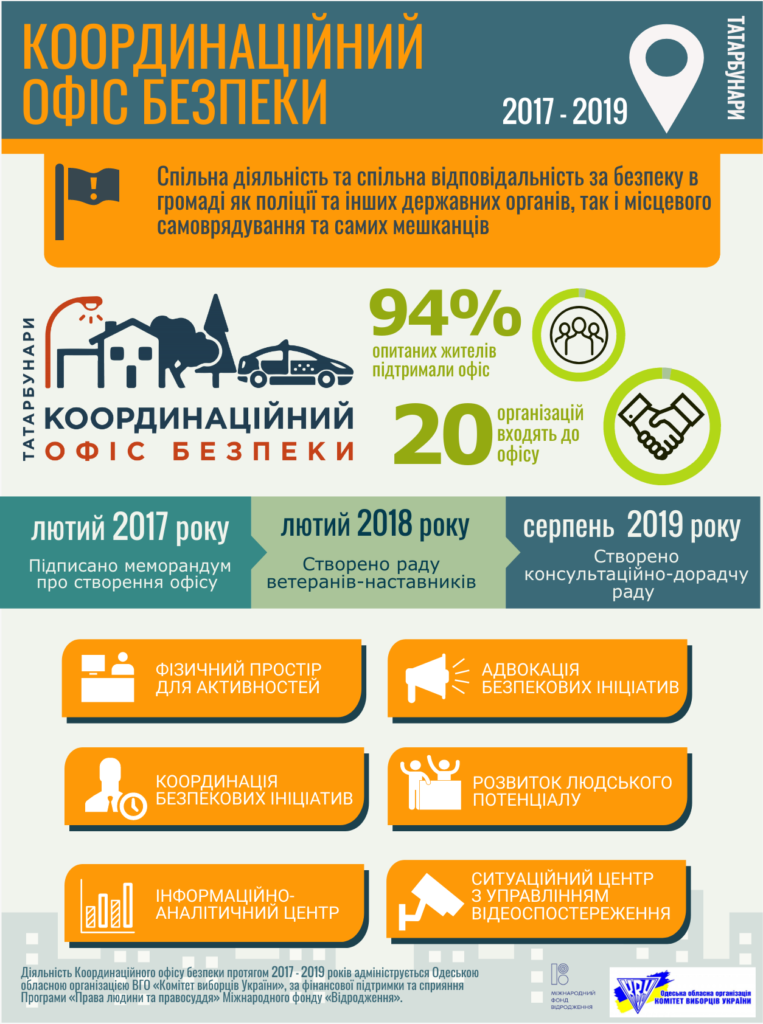
Activities of the Security Coordination Office in Tatarbunary. Infographic: Odesa Regional Organization of the All‑Ukrainian NGO "Committee of Voters of Ukraine".
What does this provide?
- an understanding of the community's security situation, including identification of security risks.
- an understanding of the potential and capacity of all relevant actors — state, non‑state, formal and informal — in developing a safe community environment.
- an assessment of the state of partnership and communication in the community on security issues.
- an evidence base to confirm problems and prioritize activities for building a safe community environment.
- an empirical basis for long‑term solutions to build a safe community environment, for example the development of security strategies, programs, plans and other measures.
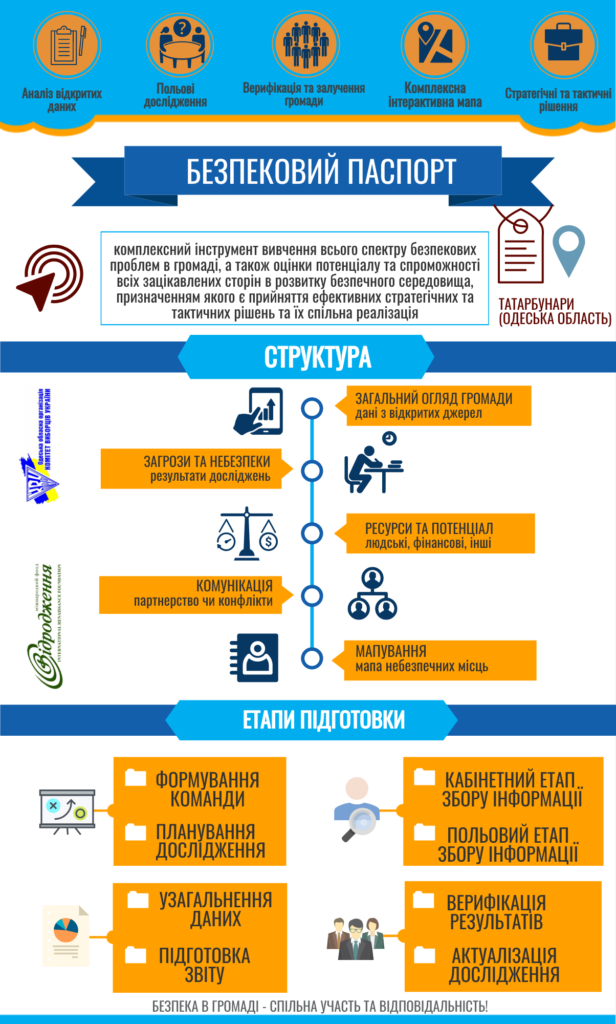
'Community Safety Passport' approach. Infographic: Odesa Regional Organization of the All‑Ukrainian NGO 'Committee of Voters of Ukraine'.
How is it prepared?
1. Forming the team
An effective team (initiative or working group) should include representatives from different sides — community activists, local council members, police, the State Emergency Service (DSNS), and other specialists. Coordination is often taken on by civic activists, although in some communities the initiative was driven by police representatives or municipal officials. In any case, duties and responsibilities should be allocated among all partners according to their authority, expertise, and availability.
2. Planning the research
At this stage it is important to record answers to the following questions:
- What exactly are we studying and where can we obtain the necessary information?
- How to obtain a representative snapshot of the whole community rather than only specific groups?
- How to verify the collected data and involve the community in the research process?
At this stage it is important to weigh the human and financial resources that can be mobilized for the research. Based on these factors, the methodology and duration of the study are agreed. For example, if the community has sufficient funds or knows how to attract them, it can hire a sociological agency to conduct a full sociological study. If resources are limited, it is advisable to choose a simple resident survey conducted by trained volunteers, which will be much cheaper. However, if the community conducts the research itself, it is better not to use the term 'sociological study'; instead, indicate 'opinion study'.
3. 'Desk-based stage'
Given the development of information resources and access to public information, much open data can be obtained without leaving the office. This includes various statistics from local authorities, the police or rescuers via official websites or by submitting information requests. Media publications, discussions on local forums, and social media posts can also provide considerable information on community safety issues.
It is important here to consider the status of the information — whether it is official data or the subjective assessment of individual people, even local leaders.
4. 'Field stage'
At this stage information is obtained through direct or indirect contact with community residents and representatives of specific social or professional groups. If conducting the research independently, we recommend carrying out this stage in the following sequence:
- Expert interviews.They are conducted informally using a minimal scenario with community leaders and officials responsible for local safety — for example, the city mayor, the head or starosta of the OTG, the police chief or DSNS commander, and civic leaders. Information obtained this way will provide an overall picture of the situation and outline a range of potential problems.
- Focus group discussions. The main purpose of focus groups is to obtain in-depth information about the problem, its characteristics and manifestations, possible causes and consequences, and to develop the terms of reference for subsequent surveying. They should be conducted using a prepared guide with a pre-defined list of questions and discussion topics in small groups of up to 10 people from different target audiences. This allows examining community safety issues from multiple perspectives and balancing the information. In particular, focus groups can be held with drivers, pedestrians, police officers, rescuers, representatives of community formations involved in maintaining public order, hunters, civic activists, teachers and school administrators, heads of OSBB (condominium associations), local council deputies, and local council chairs and secretaries.
- Surveys.They are conducted using a prepared questionnaire, which may contain closed questions with answer options, open questions where the respondent formulates their own answer, or a mix of closed and open questions. If the questionnaire contains mostly closed questions, the data are easier to process and standardize. Open questions are harder to summarize, but such information is often unique or may reveal a different aspect of the issues under study. We recommend avoiding a large number of open questions and formulating closed questions with answer options as clearly, unambiguously, and exhaustively as possible.
Some questions should aim to collect socio-demographic data, such as gender, age, employment, and area of residence. This will make the survey results more inclusive and reveal the views of different age groups or residents of different neighborhoods on a given issue. It is advisable to run a pilot survey to check question clarity, the optimal number of questions, completion time, and so on. Based on the pilot, the questionnaire may need revision, reducing or increasing the number of questions or changing wording. For convenience, use both paper questionnaires and an electronic form, for example a Google Form. Paper surveys should be conducted in the busiest locations: public offices (pension offices, registration authorities, social welfare departments, land department), shops, markets, streets, squares, village councils, libraries, and workplaces. The electronic questionnaire should be posted on informational websites, social networks, and forums. The electronic form is much easier to process, but it also risks being completed by inappropriate respondents, for example minors, residents of other communities, or even people from other countries.
See a sample online questionnaire below:
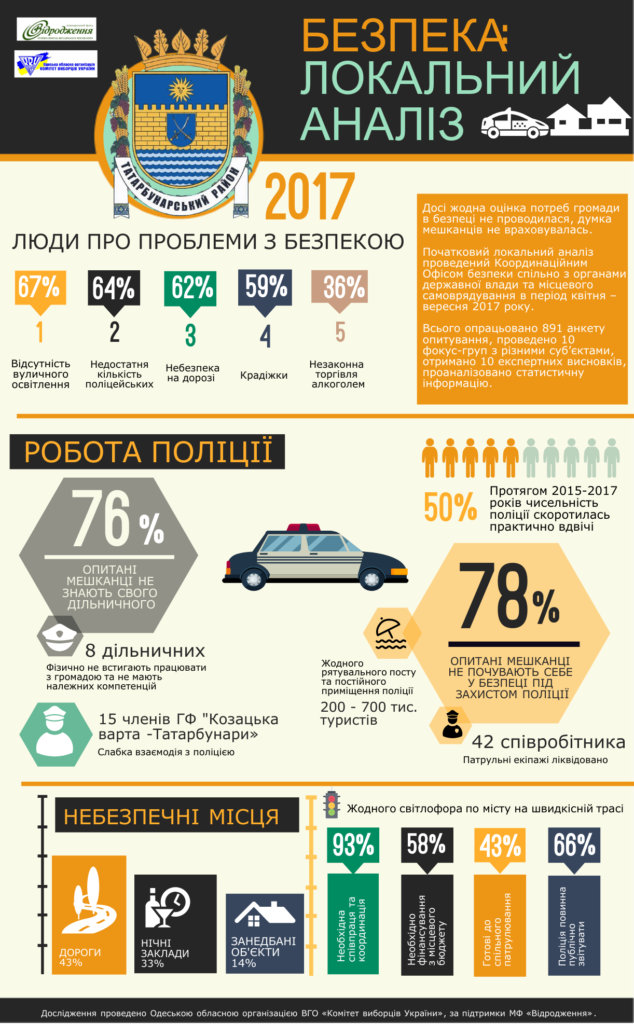
Results of the local analysis on community safety. Infographic: Odesa Regional Branch of the All‑Ukrainian Public Organization 'Committee of Voters of Ukraine'.
5. Data summary
To summarize data from paper questionnaires, you can use Excel or other software that handles datasets. Online questionnaires are summarized automatically using Google Forms. We recommend entering paper questionnaires into the Google Form as well; this allows the program to correctly calculate the data and automatically generate tables and charts. Based on analysis of the collected information, problems are classified as follows:
- issues that can be resolved by the police or other state authorities;
- issues that fall within the exclusive competence of local self-government;
- issues that require comprehensive joint efforts.
Conclusions and aggregated data should be presented in the main body of the report, which we strongly recommend visualizing with infographics and charts and enlivening with quotes, practical cases, and illustrative images. As appendices to the report, also include the most important primary sources or links to them, a description of the methodology used, data collection forms, and contacts of the authorities responsible for community safety.
6. Verification and updating of results
The prepared report should be presented to and discussed with the community via a roundtable, public hearings, or another format that allows two-way communication between the researchers and the community.
The situation in the community can also change, both with the emergence of new security risks and with changes in the capacity of key actors. Often even personnel changes — for example the city mayor or the head of the police department — can affect the development of a safe environment in the community, and this should be taken into account. Therefore, it is advisable to update the data of the "security passport" approximately once a year.
In general, community involvement is important not only at the stage of verifying results but also during information gathering. We support the approach that the community should not be a passive subject of study but an active participant in planning and researching safe-environment issues. In particular, residents tend to trust local volunteers far more during surveys than outsiders, even if the outsiders are more qualified.
What is the approximate structure?
The uniqueness of the "security passport" tool lies in its different levels of detail and depth, which can be used sequentially or independently. Each successive level of preparing the "security passport" provides deeper and more specific information about the state of safety in the community, but also requires more effort to research.
Level 1. General overview of the community
During the desk-based stage we obtain basic information about the community with regard to safety factors: community size and location, population profile, local budget, presence of industrial or infrastructure facilities, natural characteristics and other factors.
We are interested in:
- Is it a rural hromada with a small budget or a regional center with potential for cross-border investment?
- Is it a transport hub with a potentially hazardous railway station?
- Is the community located in an industrial region with a high concentration of hazardous industries?
- Is it a community on the Black Sea coast facing illegal fishing and lacking rescue stations?
- Or might the main security problem be a high-speed international highway that runs through the entire city?
Level 2. Threats and hazards
Here we determine the overall sense of safety in a given area, assess the effectiveness of the police and local government on the ground, and identify priority areas of activity. Thanks to the results of the field-stage research, we can assess the main security risks and threats, classify and describe them. For example, regarding crime, domestic violence, bullying, environmental problems, emergencies, the condition of road infrastructure and traffic accidents, and social conflicts in the community. It is important during the research process to identify the situation of vulnerable groups — including people with substance use disorders, ethnic minorities, and former prisoners — who are often deprived of full integration into community life and are perceived by the community as a real or potential threat to its safety.
For example, residents of the town of Tatarbunary in Odesa region, during a 2017 survey, singled out the following safety factors (previously the opinions of local residents had not been researched or taken into account):
1. Lack of street lighting – 67%.
2. Lack or insufficient number of police — district officers, patrols, patrol cars — 64%.
3. Danger on the roads: road conditions, lack of traffic lights and road signs, traffic violations — 62%.
4. Theft on the street, at home, and in transport – 59%; Violations of alcohol sales regulations – 36%.
5. Among locations, the most dangerous places were city parks, the PMK neighborhood, the Melrose nightclub, and the outskirts of the town.
Level 3. Resources and potential
At this level we determine what resources and potential the community has to resolve security issues. We are interested in human, financial and material resources. Specifically:
- Is the number of police and other law enforcement bodies sufficient, and are they properly staffed?
- Does municipal police (varta), community formations, and self‑defense groups operate?
- What state and local funding is allocated to security issues?
- Which local targeted programs have been adopted and are actually funded in the community, in particular security, environmental protection, healthcare, poverty reduction, etc.?
- Is there socially responsible business in the community, and is it possible to engage its resources?
It is important to know whether the community has technical and information systems that help respond to emergency incidents, such as an operational alert system and video surveillance, “smart” management of patrols, lighting and traffic lights, and panic buttons in public places. It should be noted that the use of video surveillance cameras is one of the most common tools for improving community safety, but such systems in communities often operate without proper documentation and have problems with analysis, storage and use of the collected data.
The example of the Tatarbunary district of Odesa region shows significant police reductions, almost halving the force (2015 – 87 staff, including 14 district officers; 2017 – 42 staff, 8 district officers), and patrol units were disbanded. These changes reduced response times and virtually eliminated crime prevention. These factors also limit the police’s ability to understand and address community problems. A 2017 survey in Tatarbunary district showed that 77.8% of people do not feel safe under police protection, and 75.6% of respondents do not know their district police officer.
Level 4. Partnership and Communication
Even when a community understands safety problems and has some resources to address them, it is difficult to move forward without effective communication and cooperation among key actors. Accordingly, this level examines:
- existing forms of interaction, communication and coordination among those responsible for community safety;
- the presence of coordination groups, platforms and offices;
- the frequency, format and channels of coordination;
- forms of informing and engaging the community.
It is also important to understand the existence or potential grounds for conflicts and misunderstandings among key parties:
- “police – local authorities”;
- “patrol police – national police”;
- “municipal police – police”;
- “community activists – against everyone” and other lines.
For example, in early 2017 the Odesa regional branch of the All‑Ukrainian NGO “Committee of Voters of Ukraine” established the Security Coordination Office as a joint information and coordination center for developing a safe community environment.Initially, the goals and tasks of the Security Coordination Office, as well as its working format, are set out in the Memorandum. During 2017–2018, 20 governmental and non-governmental organizations joined the Memorandum. At the beginning of 2018, a Council of Veteran Mentors was created at the Coordination Office; on a voluntary basis they mentor police officers, take part in joint patrols, and participate in outreach and training events. In 2019 the Security Coordination Office was formalized by creating an advisory body under the executive committee of the Tatarbunary City Council.
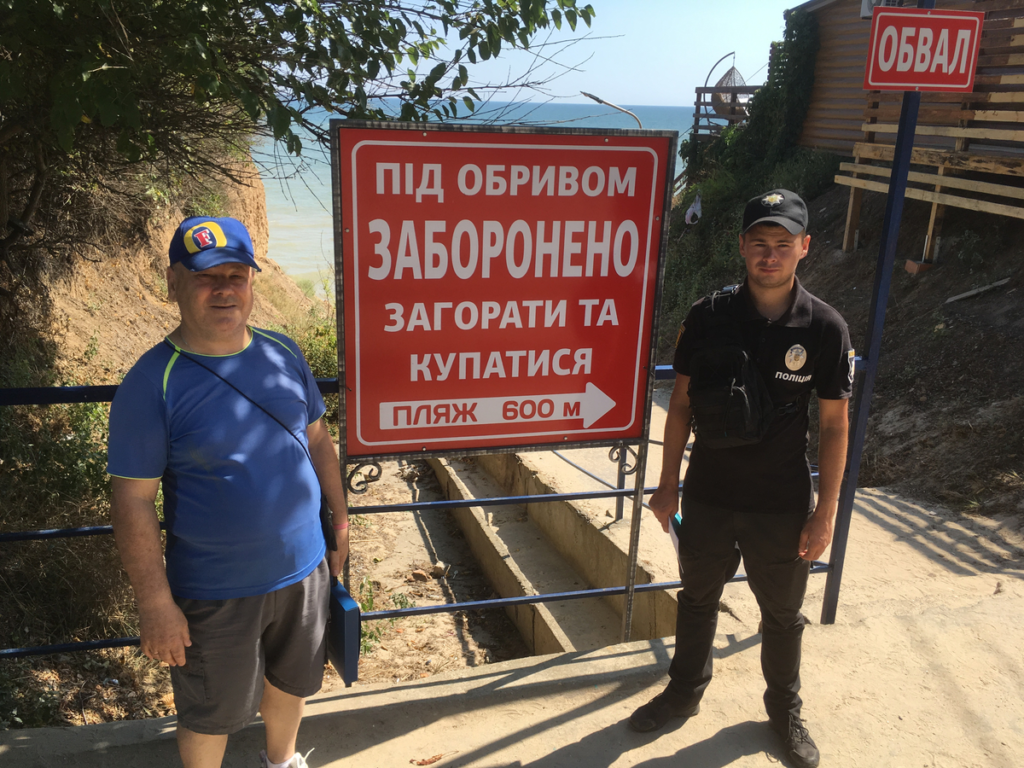
Monitoring by the Security Coordination Office in Tatarbunary of safety compliance at resort facilities. Photo: Odesa Regional Branch of the All-Ukrainian NGO "Committee of Voters of Ukraine".
Level 5. Mapping (cartography)
This level requires not only collecting location-linked information but also technical solutions to create and use an integrated map of hazardous locations in the community. Multiple map layers are possible: a map of hazardous places based on survey results, a crime map, a road-traffic accident map, a map of technological hazards (for example dangerous facilities, fires), and a map of video surveillance cameras, both municipal and private. In addition to the practical information each map provides — for example to adjust patrol routes or install street lighting — combining these layers reveals systemic problems in community safety provision.