

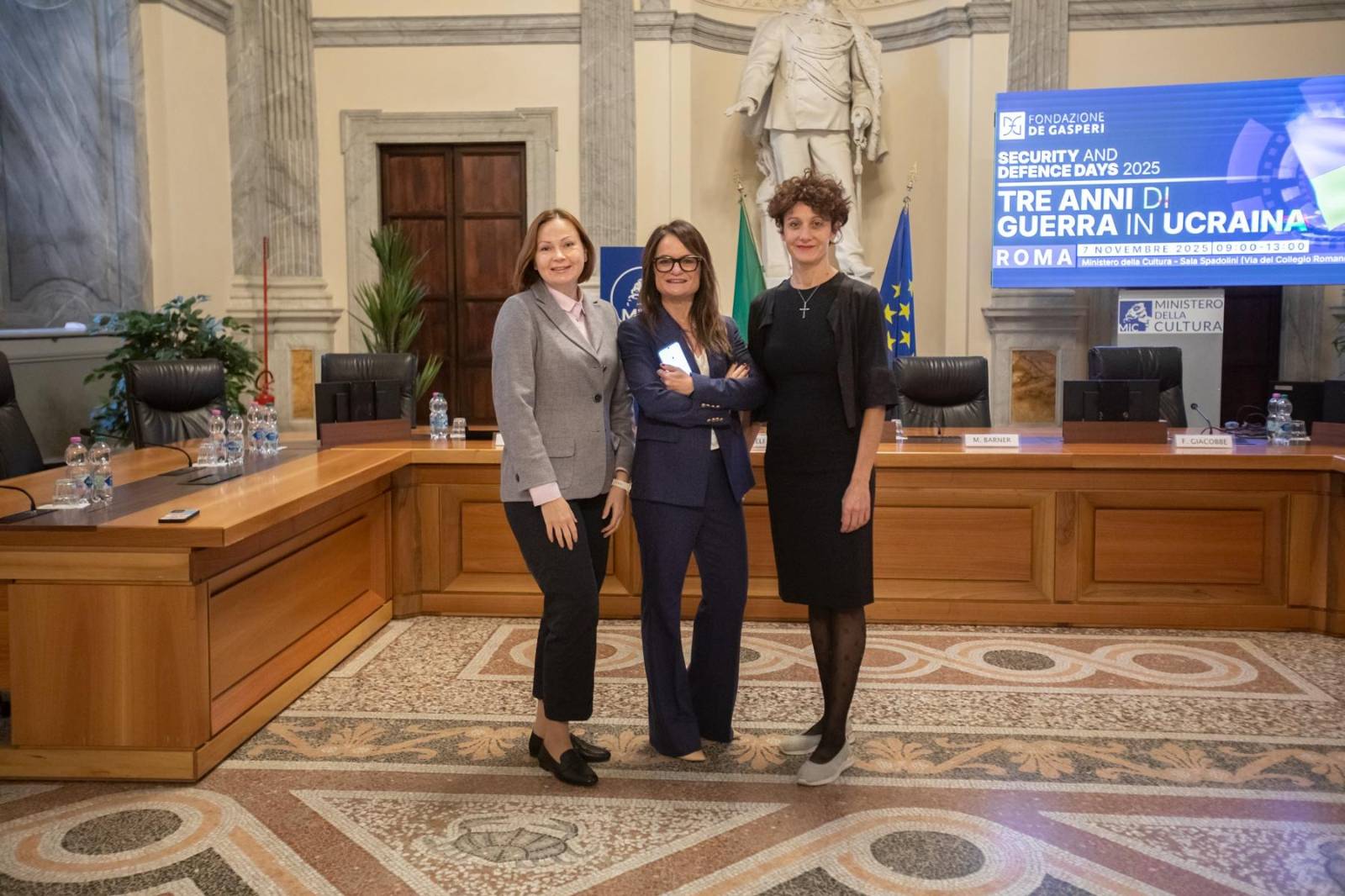
On November 7, the Chair of the Board of the Institute for Peace and Common Ground, Alona Horova, spoke in Rome at the international conference Security and Defence Days: “Three Years of War in Ukraine,” organized by the Fondazione De Gasperi.
The conference brought together government representatives, international organizations, research and analytical centers, civil society, and the media to discuss Ukraine’s path toward peace, security, reconstruction, and Euro-Atlantic integration amid the ongoing war.
In her speech, Alona Horova presented a vision of Ukraine’s reconstruction centered on people, trust, and communities.
When they talk about rebuilding Ukraine, they show pictures of new buildings and bridges.
But what about rebuilding us? We are not only rebuilding infrastructure – we are rebuilding trust, human connections, and communities’ ability to live together after trauma.
Alona emphasized that real reconstruction begins not with concrete and bricks, but with people.

Because a divided society cannot sustain reconstruction, traumatized communities cannot maintain democratic institutions, and a population without trust becomes an easy target for disinformation and manipulation.
The central idea of her speech was Inclusive Recovery and Resilience – as the foundation for a secure and cohesive society.

Inclusive means reconstruction based on people’s and communities’ participation:
- Communities as decision-makers, not recipients. They set their own priorities, take responsibility, and thus ensure sustainable results.
- The principles of “do no harm” and “do better” strengthen horizontal connections, avoid dependencies, and prevent the repetition of past mistakes.
- Conflict sensitivity at every step. Every decision must consider the context of war and the experiences of those who have lived through occupation, displacement, or loss.
- Democratic practice now. Don’t wait for peace to build democracy — teach dialogue, shared decision-making, and mutual support already today, in communities, schools, and temporary centers.
“We’re not waiting for the war to end to build democracy.
We’re doing it now – under shelling, under pressure.
Because victory in war must be secured by victory in peace.
And that victory is only possible when communities are strong, engaged, and united.”
Rebuilding social cohesion is a matter of security, not only social policy.
Without strong horizontal connections and trust, any investment in infrastructure risks being unsustainable.
This approach is not about returning to what was, but about building something better, fairer, and more resilient – through trust, participation, and the restoration of human connections.

Description for this block. Use this space for describing your block. Any text will do. Description for this block. You can use this space for describing your block.